
How to Master AI Search Optimization (AIO): A Complete Guide for the Future
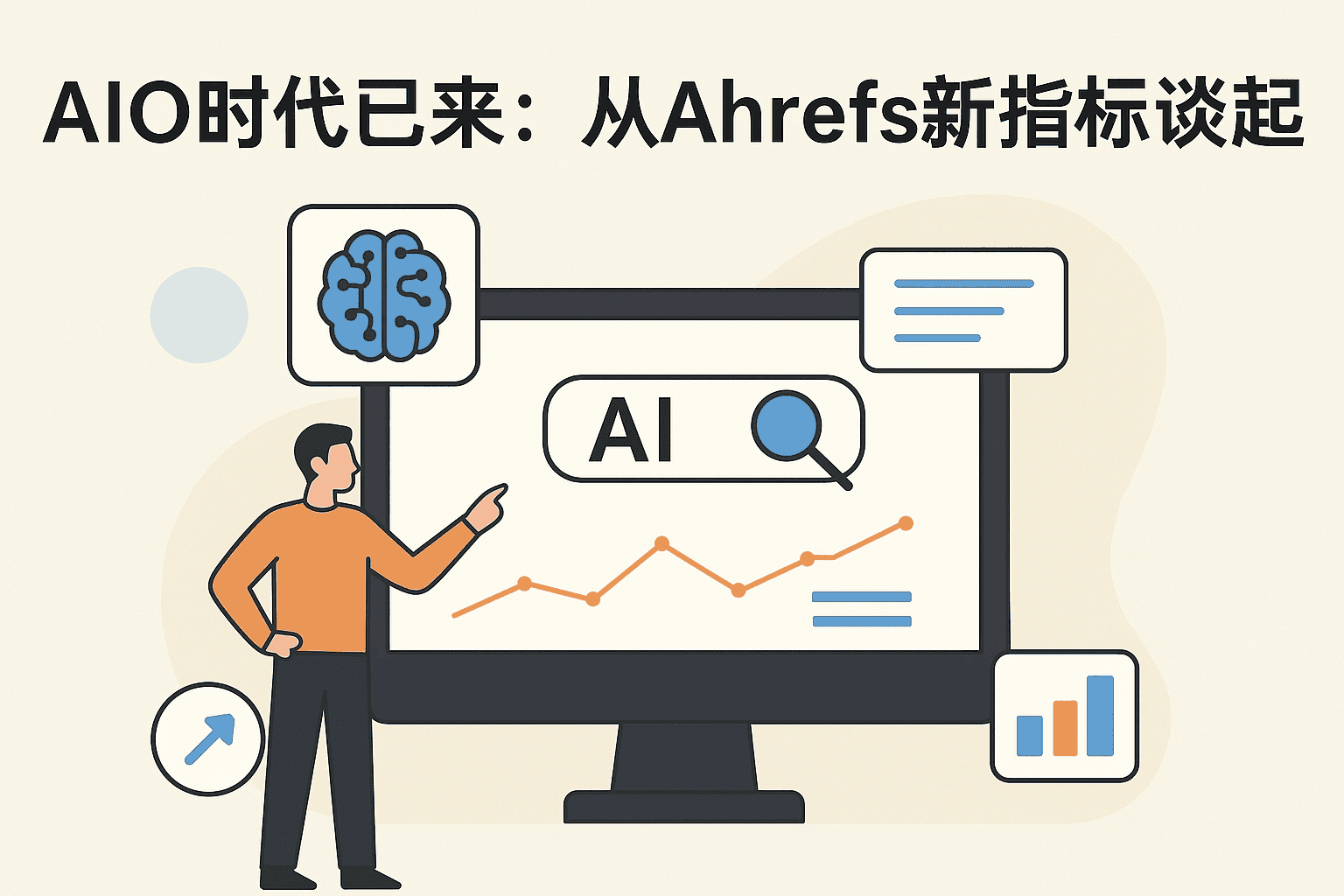
AI Search Optimization (AIO) is, in essence, the practice of using a set of optimization strategies to get your brand and content cited and recommended in the answers generated by AI tools like Google AI Overviews, ChatGPT, and Perplexity.
1. The AIO Era Is Here: A Look at Ahrefs' New Metric
If you keep up with leading SEO tools, you may have noticed a critical new section in Ahrefs' site performance dashboard: AI Citation.
This metric provides a clear view of your website's performance in major AI-driven search answers:
Citations: The total number of times your website has been cited in AI-generated responses.
Pages: The number of pages on your site that have been cited by AI.
The platforms Ahrefs tracks cover the core forms of AI search today:
Google AI Overviews (AIO): The AI-powered summaries displayed at the top of Google's search results, designed to directly satisfy user intent.
ChatGPT: The archetypal conversational large language model, whose answers significantly shape user perception.
Perplexity: A high-profile AI search engine that combines real-time web data to generate highly accurate answers.
By placing this data front and center, Ahrefs is sending a clear signal: AI Search Optimization (AIO) is rapidly evolving from a niche concept into a core focus for all website operators.
2. What is AI Search Optimization (AIO)?
While the industry is buzzing with new acronyms like GEO (Generative Engine Optimization), AEO (Answer Engine Optimization), and LLMO (Large Language Model Optimization), they all share the same fundamental goal.
AI Search Optimization (AIO) is, in essence, the practice of using a set of optimization strategies to get your brand and content cited and recommended in the answers generated by AI tools like Google AI Overviews, ChatGPT, and Perplexity.
AIO has two primary objectives:
Brand Mention: Getting your brand name to appear in AI-generated answers.
Content Citation: Making your website a source for AI answers, complete with a clickable link.
Achieving these goals means turning AI search into a new, sustainable channel for high-quality website traffic.
3. Why Is AIO Crucial?
1. Higher Traffic Conversion Rates
Studies have shown that users arriving from AI search convert at an average rate 4.4 times higher than those from traditional organic search.
This stems from a fundamental difference in the user experience:
Traditional Search: A keyword-driven experience where users must jump between multiple links to gather information, resulting in a long and fragmented decision-making process.
AI Search: A conversational experience where users engage in a deep dialogue around a topic within a single window. The user journey—from Awareness and Interest to Desire and Action—is highly compressed and integrated.
When a user's needs are clarified and amplified through a conversation with an AI, a recommendation for your brand at that critical moment is incredibly powerful. Being cited in an AI answer means you appear at the exact moment the user needs you most.
2. The Future Dominant Source of Traffic
While traditional search still accounts for the majority of traffic today, AI search is growing at an astonishing pace. According to projections by Semrush, the traffic volume from AI search could surpass traditional search by 2029. Establishing your presence now is a strategic move to secure future traffic leadership.
4. How to Systematically Implement AI Search Optimization (AIO)
Your AIO strategy should be built around its two core objectives.
Objective 1: Increase Brand Mentions in AI Answers
For an AI to "mention you," it must first "know you" and "trust you" based on a wide range of third-party data.
Strategy 1: Build Broad Third-Party Authority
This is similar to traditional link building but with a greater focus on enhancing your brand's credibility in the eyes of an AI.
High-Quality Listicles/Reviews: Get featured in articles like "Top 10 Tools for X" or "In-Depth Review of Product Y."
Industry Expert & Media Mentions: Be cited by industry KOLs or authoritative publications.
Interviews & Podcasts: Participate as a guest to organically introduce your brand.
Authoritative Citations: Earn mentions from Wikipedia, government sites, academic institutions, and industry associations.
Niche & Local Mentions: Appear on highly relevant industry or local business websites.
Strategy 2: Optimize Performance on Review & Directory Platforms
These platforms are key sources for AI to assess a brand's "social proof."
For Local Businesses: Optimize your Google Business Profile, Yelp, etc.
For SaaS: Focus on professional review sites like Capterra, G2, and TrustRadius.
For E-commerce: Pay attention to TrustPilot, Google Store Ratings, Amazon brand ratings, etc.
Strategy 3: Actively Engage in High-Quality Communities
AI models crawl platforms like Reddit, Quora, and niche industry forums to understand public opinion.
Provide valuable answers in relevant discussions and mention your brand where appropriate.
Strategy 4: Unify and Manage All Digital Assets
Ensure consistency and activity across all your official channels—website, YouTube, LinkedIn, Facebook, etc. Together, they form the complete picture of your brand for an AI to evaluate.
Objective 2: Make Your Website a Content Source for AI Answers
This requires your site to be AI-friendly on both a technical and content level, with Google's E-E-A-T (Experience, Expertise, Authoritativeness, and Trustworthiness) principles at its core.
1. Technical Layer: Build an AI-Understandable Website
Fundamental Technical SEO: Ensure your site is crawlable and indexable, with excellent mobile-friendliness, fast loading speeds, and HTTPS.
Clear Site Architecture: Use a logical internal linking structure to help AI understand the relationships between your pages.
Implement Schema Markup (Structured Data):
Be Precise: Choose the most appropriate Schema type for each page (e.g., Product, Article, FAQPage). Don't misuse it.
Generate Efficiently: Use tools like ChatGPT to generate JSON-LD schema code based on your page's content.
Validate Rigorously: Test your implementation with tools like the Google Rich Results Test or Schema.org Validator.
Conduct Regular Content Audits: Quarterly, review your content and prune, merge, or optimize underperforming pages to improve overall site quality.
Deploy LLMs.txt (Optional): While its impact is still being studied, creating this file to guide large language models is a low-effort, proactive measure.
2. Content Layer: Create High-Quality, Citable Content
Adhere to E-E-A-T: Create content that demonstrates real experience, deep expertise, strong authority, and high trustworthiness. This is the foundation for earning AI's trust.
Provide Clear, Direct Answers: Address potential user questions with concise, well-structured answers (using lists, definitions, steps, etc.).
Support Claims with Data and Sources: Cite authoritative data and studies, and link to your sources to enhance credibility.
Keep Content Fresh: Regularly update your information to ensure it remains timely and accurate.
5. Conclusion: From SEO to Holistic Digital Marketing
AI Search Optimization is not a replacement for traditional SEO but its natural evolution and expansion. It demands that we adopt a holistic digital marketing mindset.
The search engines of the future, whether traditional or AI-driven, will no longer judge a website in isolation. They will assess a brand's reputation, influence, and credibility across the entire internet ecosystem and allocate visibility and traffic accordingly.
As the landscape changes, our roles must evolve from being SEO specialists focused solely on search engines to becoming digital marketing strategists capable of building brand influence across all channels.
Comments (0)